


If you have ever checked a company on the Nigerian Exchange (NGX) and noticed a short code beside its name, you may have wondered what it means.
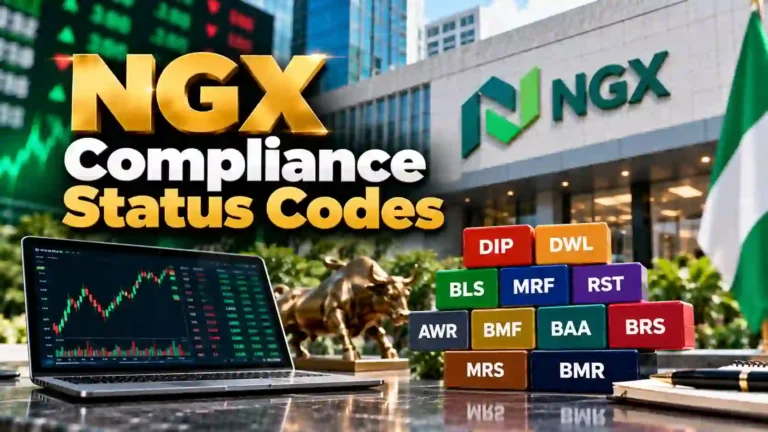
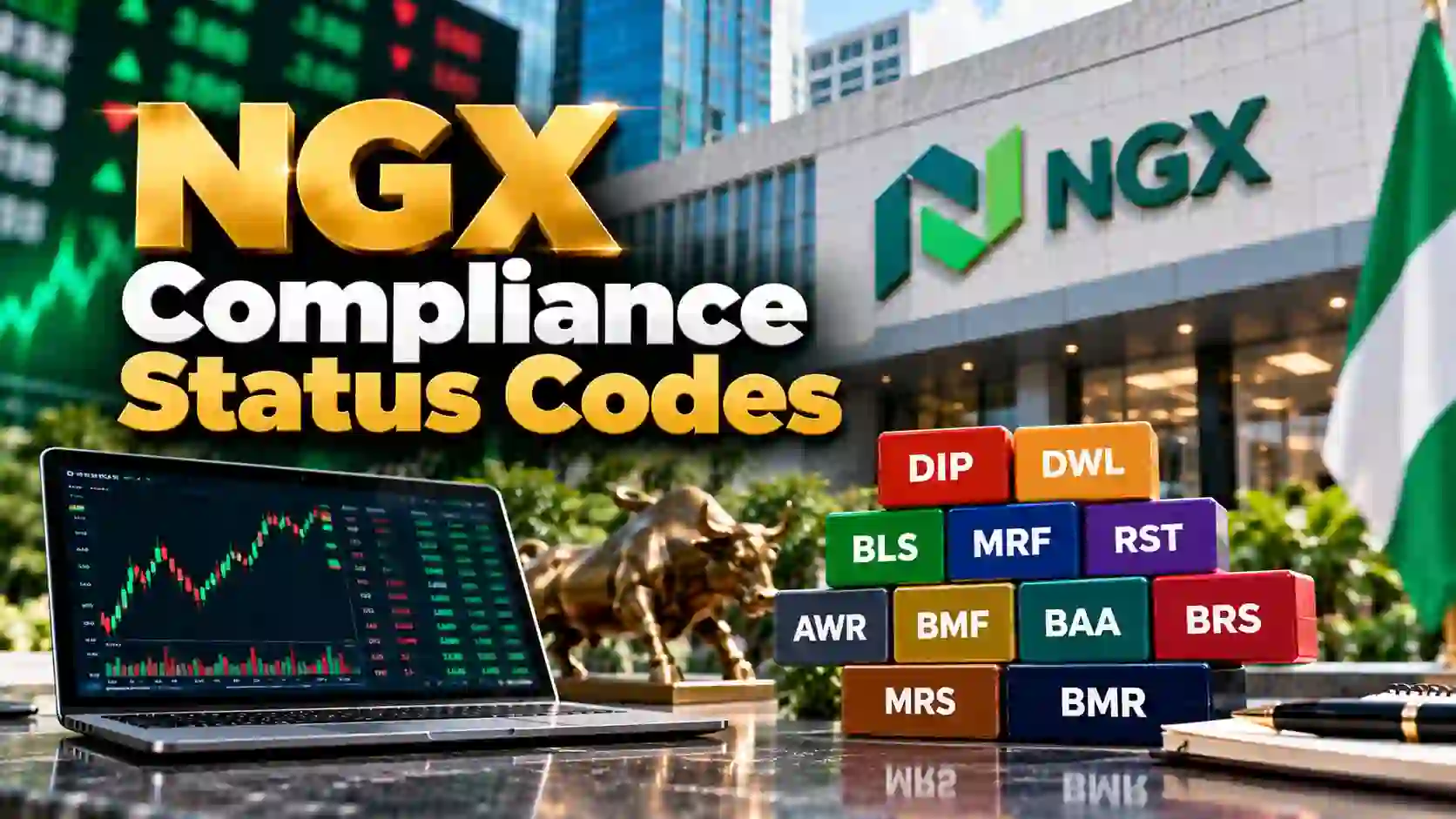
You may see codes such as BLS, MRF, DWL, DIP, AWR, RST, BMF, BAA, BRS, MRS or BMR attached to a listed company.
These are not random abbreviations.
They are NGX Compliance Status Indicator (CSI) codes, and they provide investors with important information about the compliance status of companies listed on the Nigerian Exchange.
For example, if you see DIP beside a company, it means Delisting in Progress. If you see MRF, the company has Missed a Regulatory Filing. A company marked DWL is on the Delisting Watch-list.
Understanding these NGX status indicators is important because the information can affect how an investor researches and evaluates a listed company.
This guide explains all the major NGX Compliance Status Indicator codes, what they mean, why NGX uses them, and what investors should understand before buying shares in a company carrying one of these indicators.
What Are NGX Compliance Status Indicator Codes?
NGX Compliance Status Indicator (CSI) codes are codes used by the Nigerian Exchange to identify certain compliance or regulatory situations involving listed companies.
According to NGX, the codes are designed to improve market transparency, provide timely information for investment decisions and support investor protection.
The codes can indicate issues such as:
- Missed regulatory filings
- Falling below listing standards
- Delisting proceedings
- Restructuring
- Awaiting regulatory approval
- Combinations of these situations
The indicator can be appended to the security or company name in relevant market-data systems, allowing investors and market participants to see the company’s compliance status.
NGX states that the code is updated when necessary and removed when the company rectifies the relevant compliance issue.
Why Does NGX Use Compliance Status Indicators?
Imagine you are researching a Nigerian company before buying its shares.
You look at its share price and see that the stock appears cheap.
Without additional information, you might assume the low price represents an opportunity.
But what if the company has failed to meet a regulatory filing requirement?
Or what if it is currently undergoing a delisting process?
Or what if it has fallen below the exchange’s continuing listing standards?
This is where the NGX compliance status indicator becomes important.
The indicator gives investors another piece of information to consider before making an investment decision.
It does not automatically mean that a company is a bad investment.
However, it tells you that you should investigate the situation further.
Complete List of NGX Compliance Status Indicator Codes
The major NGX Compliance Status Indicator codes include:
| Code | Meaning |
|---|---|
| BLS | Below Listing Standard |
| MRF | Missed Regulatory Filing |
| DWL | Delisting Watch-list |
| DIP | Delisting in Progress |
| AWR | Awaiting Regulatory Approval |
| RST | Restructuring |
| BMF | Below Listing Standard and Missed Regulatory Filing |
| BAA | Below Listing Standard and Awaiting Regulatory Approval |
| BRS | Below Listing Standard and Restructuring |
| MRS | Missed Regulatory Filing and Restructuring |
| BMR | Below Listing Standard, Missed Regulatory Filing and Restructuring |
These codes are based on the compliance-status framework published by the Nigerian Exchange.
Now let’s explain what each one means.
What Does BLS Mean on NGX?
BLS means Below Listing Standard.
When a company carries the BLS indicator, it means there are deficiencies relating to the company’s continuing listing standards.
In simple terms, the company is not currently meeting one or more requirements applicable to maintaining its listing standard.
This does not necessarily mean the company is being delisted immediately.
However, it is a signal that investors should investigate the reason for the BLS status and check whether the company has taken steps to resolve the issue.
What should an investor do when they see BLS?
Check:
- The company’s latest financial statements
- NGX notices
- Regulatory announcements
- The company’s disclosures
- Any information explaining the compliance deficiency
Do not make an investment decision based solely on the share price.
What Does MRF Mean on NGX?
MRF means Missed Regulatory Filing.
This indicates that an issuer has missed a regulatory filing deadline.
Companies listed on the Nigerian Exchange have reporting and disclosure obligations.
When a company fails to submit a required filing within the applicable deadline, it may receive the MRF status indicator.
For an investor, this is an important warning to investigate the company’s latest disclosures and understand why the filing was missed.
What Does DWL Mean on NGX?
DWL means Delisting Watch-list.
This is one of the most important NGX status indicators for investors to understand.
According to NGX, companies placed on the Delisting Watch-list have received a delisting notice, but the delisting process has been put on hold because the company has received a stay of action for a defined period while it works to address the issues that led to the delisting notice.
If the company fails to resolve the issue within the defined period or an applicable extension, the hold on the delisting process can be lifted.
Does DWL mean the company is already delisted?
No.
DWL means the company is on a Delisting Watch-list.
The company remains listed, but the status indicates a serious compliance or listing issue that investors should investigate.
What Does DIP Mean on NGX?
DIP means Delisting in Progress.
This is particularly important.
NGX defines DIP as companies that are in the delisting process, whether the delisting is mandatory or voluntary.
The delisting process begins with a notice of intention to delist.
Therefore, if you see DIP beside a Nigerian listed company, you should not interpret it as an ordinary market label.
It means the company’s listing status is undergoing a delisting process.
Is DIP the same as DWL?
No.
DWL — Delisting Watch-list:
The company has received a delisting notice, but the process has been put on hold under the applicable circumstances.
DIP — Delisting in Progress:
The company is actively in the delisting process.
This distinction is important for investors.
What Does AWR Mean on NGX?
AWR means Awaiting Regulatory Approval.
This status applies to companies waiting for approval or a no-objection from their primary or another relevant government regulator before releasing their audited financial statements.
AWR therefore does not necessarily mean that the company has failed financially.
It indicates that a regulatory approval or no-objection is outstanding in the circumstances covered by the indicator.
What Does RST Mean on NGX?
RST means Restructuring.
It indicates that the company is undergoing a restructuring process.
Restructuring can involve significant changes to a company’s business, operations, finances or corporate structure.
If you see RST, investors should look for official company announcements and NGX disclosures explaining the nature of the restructuring.
What Does BMF Mean on NGX?
BMF means Below Listing Standard and Missed Regulatory Filing.
This is a combination of two compliance issues:
BLS + MRF
The company has deficiencies relating to its continuing listing standards and has also missed a regulatory filing deadline.
Because two issues are represented by the same indicator, investors should conduct more detailed research before making an investment decision.
What Does BAA Mean on NGX?
BAA means Below Listing Standard and Awaiting Regulatory Approval.
This combines:
Below Listing Standard + Awaiting Regulatory Approval
The company has a listing-standard deficiency while also awaiting relevant regulatory approval or no-objection.
Investors should investigate both aspects rather than treating BAA as a single isolated issue.
What Does BRS Mean on NGX?
BRS means Below Listing Standard and Restructuring.
This indicates that the company is:
- Below the applicable listing standard; and
- Undergoing restructuring.
This combination can be particularly important when analysing a company’s financial and operational condition.
What Does MRS Mean on NGX?
MRS means Missed Regulatory Filing and Restructuring.
It combines:
MRF + RST
The company has missed a regulatory filing and is also undergoing restructuring.
Investors should therefore examine the company’s latest disclosures, financial information and restructuring announcements.
What Does BMR Mean on NGX?
BMR means Below Listing Standard, Missed Regulatory Filing and Restructuring.
This is a combination of three indicators:
- Below Listing Standard
- Missed Regulatory Filing
- Restructuring
In other words, BMR tells an investor that several compliance conditions apply to the company simultaneously.
It is therefore particularly important to research the company’s current situation before making an investment decision.
Are NGX Compliance Codes a Sign That a Company Is a Bad Investment?
Not necessarily.
This is one of the most important things to understand about NGX status codes.
The codes are status indicators, not investment ratings.
For example, a company carrying an indicator does not automatically mean that its shares will fall.
Likewise, a company without a compliance indicator is not automatically a good investment.
The purpose of the indicator is to provide relevant compliance information so investors can make better-informed decisions.
You still need to examine:
- Revenue
- Profitability
- Cash flow
- Debt
- Assets
- Management
- Corporate governance
- Industry conditions
- Valuation
- Dividend history
- Regulatory disclosures
The CSI code is one piece of the investment puzzle.
How Should Investors Use NGX Status Indicators?
Think of the status code as a research trigger.
If you see a company without a status indicator, you can continue with your normal investment analysis.
If you see something like MRF, BLS, DWL or DIP, stop and investigate.
Ask:
Why does this company have this status?
Then search for official information from NGX, the company and relevant regulators.
This approach is much better than immediately assuming that the company is either a terrible investment or a hidden opportunity.
Do NGX Compliance Codes Change?
Yes.
NGX explains that compliance status indicators are updated or appended when the need arises. Once a company rectifies the relevant compliance issue, the tag can be removed.
NGX’s FAQ also indicates that once the Exchange is notified that a company has regularised its compliance breach, reflecting the updated status can take at least 24 hours.
Therefore, an investor should not assume that an old screenshot or historical article reflects a company’s current status.
Always check the latest NGX information.
What Is the Difference Between NGX Status Codes and Stock Prices?
This is another important distinction.
A stock price tells you the market price at which shares are trading.
A compliance status indicator tells you something about the company’s regulatory/compliance position.
They answer completely different questions.
For example:
Share price:
“How much is this company’s share currently trading for?”
DIP:
“What is the compliance/listing status of this company?”
You need both market information and company information when researching an investment.
How Can I Check the Status of a Nigerian Listed Company?
When researching a company listed on NGX, investors should check official NGX information, company disclosures and relevant regulatory announcements.
Do not rely solely on:
- Facebook posts
- WhatsApp messages
- TikTok videos
- Telegram groups
- Unverified investment blogs
- Old screenshots
A company’s compliance status can change.
NGX’s own documentation explains that CSI codes are intended to provide timely compliance-related information to investors and market participants.
NGX Compliance Status Indicators Explained in Simple Terms
If you are a beginner, remember the codes this way:
BLS → The company is below a listing standard.
MRF → The company missed a regulatory filing.
DWL → The company is on the Delisting Watch-list.
DIP → Delisting is in progress.
AWR → Regulatory approval is pending.
RST → The company is restructuring.
BMF → Below listing standard + missed regulatory filing.
BAA → Below listing standard + awaiting regulatory approval.
BRS → Below listing standard + restructuring.
MRS → Missed regulatory filing + restructuring.
BMR → Below listing standard + missed regulatory filing + restructuring.
Once you understand these combinations, reading NGX market information becomes much easier.
Why Nigerian Investors Should Understand NGX Status Codes
Financial literacy is not just about knowing how to buy shares.
It is also about knowing what you are buying.
A beginner might see a company trading at a very low price and immediately think:
“This stock is cheap. Let me buy it.”
But an experienced investor asks:
Why is it cheap?
Is the company profitable?
Has it published its financial statements?
Has it missed regulatory filings?
Is it restructuring?
Is it on a delisting watch-list?
Is delisting already in progress?
These questions can completely change how you view an investment.
That is why understanding NGX compliance status indicators is an important part of learning how to invest in the Nigerian stock market.
Final Thoughts on NGX Compliance Status Indicator Codes
The NGX Compliance Status Indicator codes provide investors with useful information about the compliance and listing position of companies on the Nigerian Exchange.
Codes such as BLS, MRF, DWL, DIP, AWR and RST, as well as combined indicators such as BMF, BAA, BRS, MRS and BMR, help investors identify situations that may require additional research.
The most important thing to remember is that these codes are not buy or sell recommendations.
If you see DIP — Delisting in Progress, don’t panic, but don’t ignore it either.
If you see MRF — Missed Regulatory Filing, investigate why the filing was missed.
If you see DWL — Delisting Watch-list, understand what caused the delisting notice and whether the issue is being resolved.
The smarter approach is simple:
See the code → understand the meaning → investigate the reason → check official disclosures → then make your investment decision.
That is what informed investing in the Nigerian capital market should look like.
Frequently Asked Questions About NGX Status Codes
1. What are NGX status codes?
NGX status codes are Compliance Status Indicator (CSI) codes used to communicate certain compliance or regulatory conditions affecting listed companies.
2. What does DIP mean in the Nigerian stock market?
DIP means Delisting in Progress. It indicates that a company is in the process of being delisted, either through a mandatory or voluntary delisting process.
3. What does DWL mean on NGX?
DWL means Delisting Watch-list. It identifies companies that have received a delisting notice but whose delisting process has been put on hold under the applicable conditions.
4. What does MRF mean on NGX?
MRF means Missed Regulatory Filing. It indicates that an issuer has missed a regulatory filing deadline.
5. What does BLS mean on NGX?
BLS means Below Listing Standard and indicates deficiencies relating to continuing listing standards.
6. What does AWR mean on NGX?
AWR means Awaiting Regulatory Approval. It indicates that the company is awaiting applicable regulatory approval or no-objection in the circumstances covered by the status.
7. What does RST mean on NGX?
RST means Restructuring and indicates that the company is undergoing restructuring.
8. What does BMF mean on NGX?
BMF means Below Listing Standard and Missed Regulatory Filing.
9. What does BAA mean on NGX?
BAA means Below Listing Standard and Awaiting Regulatory Approval.
10. What does BRS mean on NGX?
BRS means Below Listing Standard and Restructuring.
11. What does MRS mean on NGX?
MRS means Missed Regulatory Filing and Restructuring.
12. What does BMR mean on NGX?
BMR means Below Listing Standard, Missed Regulatory Filing and Restructuring.
13. Does DIP mean a company has already been delisted?
No. DIP means Delisting in Progress, meaning the company is in the delisting process. It should not automatically be interpreted as meaning the delisting has already been completed.
14. Does an NGX compliance code mean I should sell the stock?
Not automatically. The code provides compliance information; it is not an investment recommendation. Investors should investigate the underlying issue and consider the company’s overall fundamentals and circumstances.
15. Can an NGX status code be removed?
Yes. NGX states that the status indicator can be removed when the company rectifies the relevant compliance issue.
16. How often are NGX status codes updated?
NGX states that the codes are updated or appended when and as the need arises.
17. Where can I check the latest NGX compliance status of a company?
Investors should check the latest information published by the Nigerian Exchange and the company’s official regulatory disclosures rather than relying on old market information or social-media posts.
About the Author