

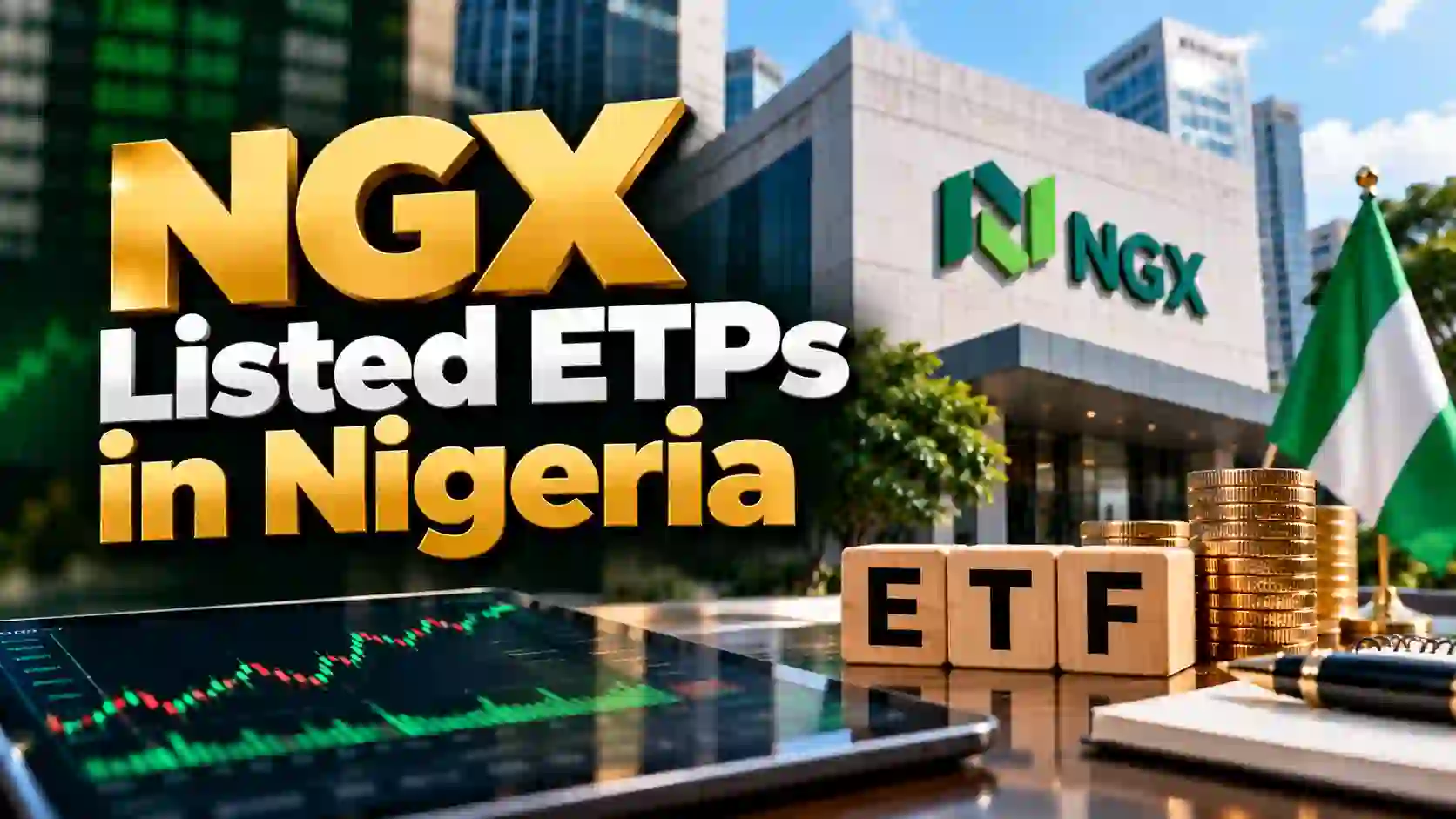
If you are looking for NGX listed ETPs in Nigeria, the Nigerian Exchange provides investors with access to a range of exchange traded products designed to give exposure to different markets, sectors, strategies and asset classes.
Exchange Traded Products, commonly called ETPs, can be an interesting option for investors who want exposure to a group of securities or a particular investment strategy without necessarily buying every individual security separately.
The NGX list supplied for this article contains 12 listed ETPs, covering areas such as consumer goods, banking, industrials, growth stocks, value stocks, pension investments, halal equities and sovereign bonds.
But what exactly are ETPs? How do ETFs work? What ETPs are listed on NGX? And how can a Nigerian investor approach this type of investment?
Let’s break it down.
What Are ETPs in Nigeria?
Exchange Traded Products (ETPs) are investment products that are traded on an exchange.
The term ETP is broader than ETF.
An Exchange Traded Fund (ETF) is one type of ETP. ETFs generally hold a basket of underlying assets and are designed to provide investors with exposure to a particular index, sector, asset class or investment strategy.
This means that instead of buying several individual companies separately, an investor may be able to purchase an ETF that provides exposure to a group of securities.
For example, an investor interested in Nigerian banking stocks could potentially use a banking-focused ETF rather than buying shares in several banks individually.
This is one of the reasons ETFs can be useful for portfolio diversification.
What ETPs Are Listed on NGX?
The supplied NGX data identifies 12 listed ETPs.
They are:
| ETP Name | Symbol |
|---|---|
| Vetiva Consumer Goods ETF | VETGOODS |
| The SIAML Pension ETF 40 | SIAMLETF40 |
| Meristem Value Exchange Traded Fund | MERVALUE |
| Vetiva Griffin 30 ETF | VETGRIF30 |
| NewGold Exchange Traded Fund | NEWGOLD |
| Vetiva Industrial ETF | VETINDETF |
| Greenwich Alpha ETF | GREENWETF |
| Vetiva Banking ETF | VETBANK |
| Lotus Halal Equity ETF | LOTUSHAL15 |
| Stanbic IBTC ETF 30 | STANBICETF30 |
| Meristem Growth Exchange Traded Fund | MERGROWTH |
| Vetiva S&P Nigeria Sovereign Bond ETF | VSPBONDETF |
This list demonstrates that the Nigerian ETP market covers several different investment themes.
What Types of ETPs Are Available on NGX?
The ETPs listed by NGX are not all designed to provide the same type of exposure.
Some focus on particular sectors, while others are designed around broader market strategies or specific asset classes.
Consumer Goods ETF
The Vetiva Consumer Goods ETF (VETGOODS) provides an investment product focused on the consumer-goods segment.
This can be useful for investors interested in gaining exposure to companies operating within the consumer sector through an exchange-traded product.
Pension ETF
The SIAML Pension ETF 40 (SIAMLETF40) is another ETP included on the NGX list.
Its name indicates a pension-oriented investment strategy.
Investors should examine the fund documentation carefully to understand its underlying holdings, objectives and applicable investment rules before investing.
Value ETF
The Meristem Value Exchange Traded Fund (MERVALUE) is focused on a value-oriented investment approach.
Value investing generally involves identifying securities that are considered relatively attractive based on their underlying fundamentals and valuation.
Griffin 30 ETF
The Vetiva Griffin 30 ETF (VETGRIF30) is another product listed on the NGX ETP list.
As with other ETFs, investors should examine the underlying index or portfolio methodology before deciding whether the product matches their investment objectives.
NewGold ETF
The NewGold Exchange Traded Fund (NEWGOLD) gives Nigerian investors access to a gold-related investment product through the exchange.
This makes it particularly different from an ETF focused purely on Nigerian equities.
Gold can behave differently from stocks, which means an investment product linked to gold may serve a different role within a diversified portfolio.
Industrial ETF
The Vetiva Industrial ETF (VETINDETF) focuses on the industrial segment.
For an investor who wants sector-specific exposure rather than simply buying individual industrial companies, a sector ETF can provide another way to approach the market.
Alpha ETF
The Greenwich Alpha ETF (GREENWETF) is also included among the listed ETPs supplied by NGX.
Investors should review the product’s investment objective and underlying holdings before making a decision.
Banking ETF
The Vetiva Banking ETF (VETBANK) focuses on the Nigerian banking sector.
Rather than selecting one individual bank, an investor can investigate whether a banking-focused ETF is appropriate for gaining broader exposure to the sector.
This can also help reduce the risk of having all of one’s banking-sector investment concentrated in a single company.
Halal Equity ETF
The Lotus Halal Equity ETF (LOTUSHAL15) provides exposure to a halal equity investment strategy.
This gives investors another option when looking for an investment product structured around specific investment principles.
Stanbic IBTC ETF 30
The Stanbic IBTC ETF 30 (STANBICETF30) is another equity-focused ETP listed on NGX.
The name indicates its connection to an ETF strategy built around 30 securities.
Investors should review the fund’s current methodology and holdings before investing.
Growth ETF
The Meristem Growth Exchange Traded Fund (MERGROWTH) is designed around a growth-oriented investment strategy.
Growth investing generally focuses on companies or securities that are expected to have stronger growth potential.
Sovereign Bond ETF
The Vetiva S&P Nigeria Sovereign Bond ETF (VSPBONDETF) is different from the equity-focused products above because it provides exposure to Nigerian sovereign bonds.
This means ETPs on NGX are not limited to shares.
An investor can also find an exchange-traded product focused on fixed-income securities.
How Do ETFs Work in Nigeria?
An ETF pools or tracks a collection of underlying investments according to its stated investment objective or methodology.
Instead of purchasing each underlying security individually, investors purchase units of the ETF.
The ETF itself is traded on the exchange.
This creates an important difference between buying an individual share and buying an ETF.
When you buy an individual company share, your investment is tied primarily to that company.
When you buy an ETF, your investment may be spread across multiple underlying securities.
For example, a banking-focused ETF could give you exposure to several banking stocks rather than requiring you to purchase each bank separately.
What Is the Difference Between an ETF and a Stock?
The easiest way to understand the difference is to think about one company versus a basket.
When you buy a company’s stock, you are buying an ownership interest in that specific company.
When you buy an ETF, you are buying units in a fund that holds or tracks a portfolio of underlying assets.
For example:
Individual stock:
You buy shares in one Nigerian bank.
Banking ETF:
You buy an ETF designed to provide exposure to a group of banking securities.
The second approach can provide greater diversification, although diversification does not eliminate investment risk.
What Is the Difference Between ETPs and ETFs?
This is an important distinction.
ETP is the broader term.
ETF is a specific type of exchange-traded product.
Therefore, every ETF is an ETP, but not every ETP necessarily has to be structured as an ETF.
The NGX data supplied for this article labels the market section “Listed ETPs”, while most of the individual securities in the list are specifically identified as ETFs.
How to Invest in NGX Listed ETPs
If you want to invest in NGX listed ETPs in Nigeria, you generally need access to the Nigerian capital market through an appropriate securities dealer or stockbroker.
Step 1: Choose a Stockbroker
Start by identifying a suitable Nigerian securities dealer.
Consider:
- Regulatory status
- Trading platform
- Fees
- Customer service
- Access to NGX-listed products
- Account-opening process
- Research tools
Do not choose a broker simply because it is popular on social media.
Step 2: Open an Investment Account
Your broker will guide you through the account-opening process and applicable Know Your Customer requirements.
Make sure your personal information is accurate and your account is properly established before trading.
Step 3: Research the ETP
Before buying an ETP, understand:
- What does it invest in?
- What index or strategy does it follow?
- What are its underlying holdings?
- What are the management fees?
- What is its trading liquidity?
- What risks are involved?
- How has the underlying market performed?
- What is the investment objective?
Never buy an ETF simply because its name sounds attractive.
Step 4: Compare the Available Products
Suppose you want exposure to Nigerian banking stocks.
Instead of immediately buying the first banking ETF you see, compare its:
- Underlying holdings
- Performance
- Fees
- Liquidity
- Investment strategy
- Tracking methodology
The same principle applies to consumer goods, industrial, growth, value and other ETFs.
Step 5: Place Your Order
Once you have researched the product and determined that it fits your investment strategy, you can place an order through your broker.
The actual price you pay depends on the market at the time your order is executed.
Why Do Investors Use ETFs?
ETFs can offer several potential advantages.
Diversification
One of the biggest attractions is diversification.
Instead of putting all your money into one company, an ETF may give you exposure to multiple underlying securities.
Convenience
Buying one ETF can be simpler than individually researching and purchasing a large number of securities.
Sector Exposure
Sector-specific ETFs can give investors exposure to particular areas of the market.
For example, the supplied NGX list includes:
- Banking
- Consumer goods
- Industrial
- Growth
- Value
Different Asset Classes
The NGX list also includes a sovereign bond ETF and a gold-related ETF, showing that exchange-traded products can provide exposure beyond traditional equities.
What Are the Risks of Investing in ETFs?
ETFs are not guaranteed investments.
Their value can rise or fall depending on the underlying assets and market conditions.
Some important risks include:
Market Risk
If the securities underlying an equity ETF fall in value, the ETF can also decline.
Liquidity Risk
Not every listed ETP will necessarily have the same level of trading activity.
Before investing, understand whether there is sufficient market activity for the product.
Tracking Risk
An ETF designed to follow an index or strategy may not perfectly replicate its underlying benchmark.
Concentration Risk
A sector ETF can still be concentrated in a particular industry.
For example, a banking ETF may provide diversification across banks but still leave the investor heavily exposed to the banking sector.
Currency and Asset Risk
Some products may have exposure to assets or markets with additional risks. Investors should understand the specific structure of each product before investing.
Are ETFs Better Than Individual Stocks?
Not necessarily.
ETFs and individual stocks serve different purposes.
If you have the knowledge and time to research individual companies, direct stock investing may suit your strategy.
If you want broader exposure to a sector, index or investment theme, an ETF may be worth considering.
The right choice depends on your:
- Investment goals
- Risk tolerance
- Time horizon
- Knowledge
- Portfolio size
- Diversification strategy
There is no single investment product that is automatically best for every Nigerian investor.
How Much Money Do You Need to Invest in an NGX ETF?
There is no single universal amount that applies to every NGX-listed ETP.
The amount you need will depend on factors such as the ETF’s market price, the number of units you want to purchase, your broker’s requirements and applicable transaction costs.
Therefore, instead of asking only, “What is the minimum amount?”, investors should also ask:
“What amount makes sense for my overall investment plan?”
Even a small investment should be approached with proper research.
How Can You Find NGX ETP Prices and Information?
Investors should obtain current information from reliable market sources.
The NGX publishes information about its listed securities and market data.
The supplied NGX page specifically identifies the ETP information as 30-minute delayed data.
This is important because investors should distinguish between delayed market information and real-time market information when making trading decisions.
Always verify the latest price, trading activity, product information and availability before placing an order.
List of NGX Listed ETPs
Based on the NGX list supplied for this article, the following 12 ETPs are listed:
- VETGOODS — Vetiva Consumer Goods ETF
- SIAMLETF40 — The SIAML Pension ETF 40
- MERVALUE — Meristem Value Exchange Traded Fund
- VETGRIF30 — Vetiva Griffin 30 ETF
- NEWGOLD — NewGold Exchange Traded Fund
- VETINDETF — Vetiva Industrial ETF
- GREENWETF — Greenwich Alpha ETF
- VETBANK — Vetiva Banking ETF
- LOTUSHAL15 — Lotus Halal Equity ETF
- STANBICETF30 — Stanbic IBTC ETF 30
- MERGROWTH — Meristem Growth Exchange Traded Fund
- VSPBONDETF — Vetiva S&P Nigeria Sovereign Bond ETF
Important: This list reflects the NGX ETP data supplied for this article and should not be interpreted as a recommendation to buy any particular product. Investors should verify current listings, prices, holdings, fees and trading status before investing.
Final Thoughts on NGX Listed ETPs in Nigeria
The Nigerian investment market is not limited to individual company shares.
NGX listed ETPs in Nigeria give investors access to different investment strategies and asset classes through exchange-traded products.
The NGX list supplied for this article includes products focused on consumer goods, banking, industrials, growth, value, gold, halal equities, pension investments and Nigerian sovereign bonds.
For a beginner, the most important thing is not to rush into buying an ETF simply because it appears on a list.
Understand what is inside the product.
Understand the strategy.
Understand the fees.
Understand the risks.
Then decide whether it belongs in your portfolio.
A good investment decision starts with understanding what you are buying.
Frequently Asked Questions About NGX Listed ETPs
1. What are NGX listed ETPs?
NGX listed ETPs are exchange-traded investment products listed on the Nigerian Exchange. The supplied NGX list includes several ETFs covering different sectors, strategies and asset classes.
2. How many ETPs are listed on NGX?
The NGX data supplied for this article contains 12 listed ETPs.
3. What is the difference between an ETF and an ETP?
ETP is a broader category of exchange-traded products, while an ETF is a specific type of ETP.
4. How can I invest in ETFs in Nigeria?
Investors generally need an appropriate securities trading account through a broker or securities dealer that provides access to the NGX market.
5. Are ETFs available on the Nigerian Exchange?
Yes. The supplied NGX data lists 12 ETPs, most of which are specifically identified as ETFs.
6. What is VETBANK?
VETBANK is the symbol for the Vetiva Banking ETF listed among the NGX ETPs supplied for this article.
7. What is NEWGOLD?
NEWGOLD is the symbol for the NewGold Exchange Traded Fund included in the NGX ETP list supplied for this article.
8. Is there a bond ETF on NGX?
Yes. The supplied list includes the Vetiva S&P Nigeria Sovereign Bond ETF, with the symbol VSPBONDETF.
9. Is there a halal ETF on NGX?
Yes. The supplied list includes the Lotus Halal Equity ETF, with the symbol LOTUSHAL15.
10. Are ETFs safer than individual stocks?
Not necessarily. ETFs can provide diversification, but their value can still fall because of movements in their underlying investments and other market risks.
11. Can I lose money investing in an ETF?
Yes. ETFs are investments whose values can rise or fall. Diversification does not eliminate investment risk.
12. Which NGX ETF is the best?
There is no universally best NGX ETF. The appropriate product depends on your investment objective, risk tolerance, time horizon and desired exposure.
13. Can I buy an ETF through a Nigerian stockbroker?
An investor can generally access exchange-listed products through an appropriate securities dealer or broker that provides access to the NGX market. Confirm the specific products available through your broker.
14. Where can I find the list of NGX ETPs?
NGX publishes information about its listed products and market data. Investors should use official NGX information and verify the latest data before making investment decisions.
About the Author